

The Disinformation Cultural Complex

This post is part of an emerging series of essays about the Battleground of the Splintered American Psyche that will be assembled in a complete volume of “A Field Guide to American Cultural Complexes” at the end of the project.
Copyright © 2025 Thomas Singer
A good friend of mine reported awakening (once again!) to the realization that he has been sucked into a vortex of nonstop news generated by and about Trump and the state of the nation. It has consumed all of my friend’s energy and thoughts. Of course, Trump wants everybody’s attention all the time. Is there anything else? Is Trump the only story worth paying attention to? Can we afford not to pay attention to Trump’s myth making juggernaut that drowns out everything else?
The Disinformation Cultural Complex
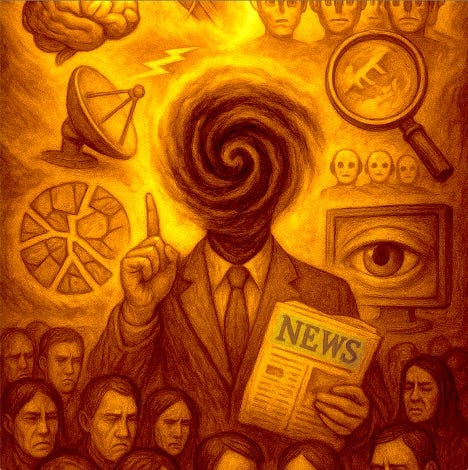
The Spiral of Untruth: The American Disinformation Cultural Complex
A faceless figure clutches a newspaper labeled NEWS, its head consumed by a black spiral—symbolizing the collapse of stable identity and coherent meaning. Around it swirl shattered emblems of knowledge—satellites, magnifying glasses, graphs, brains, and screens—all fractured and struck by lightning bolts of manipulation. Below, a fragmented crowd stares in conflicting directions, confused and disoriented. The image captures the psychological crisis at the heart of the American Disinformation cultural complex: the unraveling of shared reality in a world oversaturated with narrative warfare, algorithmic distortion, and performative outrage.
Core Emotion: Distrust, Confusion, and Existential Insecurity
At its heart, the Disinformation cultural complex is fueled by emotional disorientation. It thrives on a collapsing trust in shared reality—stoking anxiety that truth itself is unreachable or manipulated. It engenders deep suspicion of institutions, experts, journalists, science, and even one’s own judgment. The result is not simply skepticism, but also a gnawing uncertainty that anything might be false, staged, or conspiratorial.
Mythic Root: The Trickster, the Hidden Hand, and the War of Shadows
This complex draws on archetypes of deception and control: the trickster who manipulates reality, the shadow government pulling strings, the forbidden knowledge that only the initiated can see. Disinformation is not simply about lies—it evokes a mythic battlefield between seen and unseen powers. In the American psyche, this resonates with narratives of government betrayal, corporate manipulation, and apocalyptic unveiling.
Symbolic Imagery
A puppet master’s hand dangling strings over headlines
A house of mirrors reflecting distorted versions of the same event
A maze made of TV screens and hashtags
A crowd wearing headphones and blindfolds
A book labeled TRUTH set aflame
Two people arguing while a third figure watches, smiling in the shadows
Self-Reinforcing Memory
Historical events like COINTELPRO, or Counterintelligence Program, was a covert initiative initiated by the Federal Bureau of Investigation (FBI) in 1956 aimed at surveilling, infiltrating, and disrupting various political organizations deemed radical in the United States. The Iraq Weapons of Mass Destruction claims, Cold War propaganda, and media consolidation feed into collective memory. Trauma from deception—real or perceived—becomes confirmation of current suspicions. These memories function like psychic software: priming the public to see manipulation everywhere.
Black-and-White Thinking
Disinformation polarizes perception: either you are awake or you are a sheep. There is no room for complexity. Every critic is a shill; every story has an agenda; every event is staged. It breeds epistemic tribalism, where truth is not evaluated, but inherited from identity or ideology.
Repetitive Behavior
Doomscrolling through conflicting narratives, yet trusting none
Sharing conspiratorial content to “wake people up”
Constantly fact-checking or decrying fact-checkers
Rejecting mainstream sources outright while trusting obscure or anonymous ones
Mistaking confusion for insight: “If everyone’s lying, then I must be right.”
Social Effects
This complex tears the social fabric by dissolving common ground. Without shared facts, dialogue collapses. It fragments civic trust, distorts democratic debate, and prepares the ground for authoritarian solutions. It fosters learned helplessness, where people disengage from reality entirely or embrace simplistic, savior-like figures. In its most toxic form, the Disinformation cultural complex renders democracy incoherent. It becomes harder to vote, protest, educate, or heal when the very nature of fact is contested. Its effects include the rise of extremism, political violence, and emotional burnout. The mind, like the culture, becomes unmoored.
Possibility of Transformation
Despite its corrosive power, this complex holds within it a yearning: for clarity, for trust, for meaning. Its redemption lies in media literacy, relational truth-telling, and the rebuilding of epistemic trust—not as naive belief, but as shared stewardship of reality. Rituals of discernment, spaces of open dialogue, and art that unmasks manipulation without slipping into despair may help metabolize its poison. The future lies, not in silencing dissent, but in rerooting truth in relationship, humility, and common purpose.
Iconography of The Spiral of Untruth: The American Disinformation Cultural Complex
Spiral-Headed Central Figure (top center)
The faceless person with a black spiral where the head should be represents the erosion of individual identity and cognitive clarity in the age of weaponized information. The spiral evokes confusion, recursion, and emotional vortex—a mind caught in endless loops of suspicion, validation, and fear.NEWS Banner or Newspaper (clutched in hand)
The newspaper, a traditional symbol of trusted information, now appears impotent and vulnerable—clutched tightly as if it once held answers but now only raises questions. It signals the collapse of journalism as a trusted anchor of reality.Fractured Symbols of Knowledge (surrounding the spiral)
Satellites: Fragmented communication, loss of global coherence
Brains and Circuitry: Misuse of intelligence, neuropsychological manipulation
Magnifying Glasses: Obsessive scrutiny distorted by bias
Pie Charts and Graphs: The illusion of data objectivity, undermined by selective presentation
Lightning Bolts (striking symbols)
Jagged, chaotic bolts cut through the emblems of knowledge, symbolizing the violence done to truth by distortion, fearmongering, and memeified propaganda.Dazed Crowd (lower third)
Figures in the crowd gaze in different directions—some hypnotized by screens, others raising fists, others looking lost. This signals the societal effects of disinformation: polarization, isolation, rage, and helplessness.Shattered Screens (background)
Broken smartphones and televisions imply the collapse of coherent narratives. Screens, once gateways to information, now mirror our divisions back to us.Color Palette (slate, rust, and ice blue)
The palette evokes emotional coldness, decay, and digital sterility. The lack of warmth mirrors the absence of relational trust or moral grounding in a culture flooded with data but starved of wisdom.Directional Chaos (composition)
The swirling, uncentered composition mirrors the disorientation created by narrative saturation. Truth is no longer a center to hold—but a battleground fought over by images and implication.
Interpretation
This image symbolizes the Disinformation cultural complex, not as a singular lie, but as an ambient environment where the very possibility of truth is corroded. It portrays the American psyche not only as confused, but also s addicted to confusion—trapped in cycles of suspicion, seduction, and fragmentation. It asks: When everyone is a liar, who gets to be believed? And what do we become when we trust no one—not even ourselves?
Brilliantly presented. The "ambient environment where the very possibility of truth is corroded" is the environment in which a dictatorship can grow unimpeded.