

The Democratic Party’s Cultural Complex of Denial

This post is part of an emerging series of essays about the Battleground of the Splintered American Psyche that will be assembled in a complete volume of “A Field Guide to American Cultural Complexes” at the end of the project.
Copyright © 2025 Thomas Singer
The recent Democratic Primary race for the Mayor of New York that resulted in a dramatically surprising victory for Zohran Mamdani, a socialist who ran a campaign of innovative messaging and youthful hopefulness, brings to mind once again the massive failure in 2024 of the Democratic party to deal with Biden's decline in a timely, direct, and transparent manner. In the face of Mamdani's victory, we are reminded of how costly the cultural complex of denial and the holding on to established power at any cost can be to the future of the country. Simultaneously, we have witnessed how liberating it can be to allow new political, social and psychological energies to emerge which, if nothing else, the MAGA movement has demonstrated from the opposite side of the aisle.
The Democratic Party’s Cultural Complex of Denial
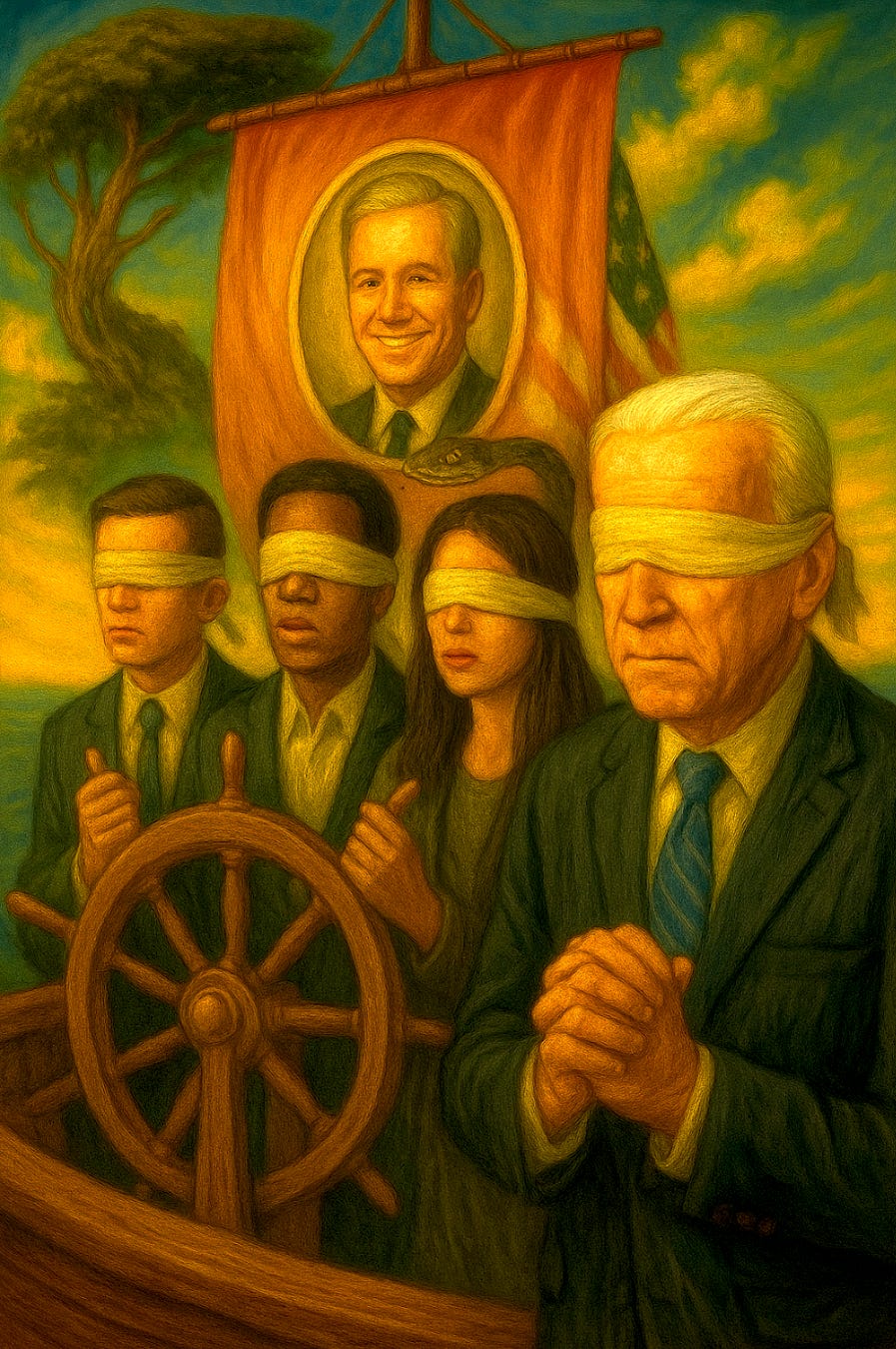
The Party That Would Not See: A Portrait of Democratic Denial
A symbolic rendering of the Democratic cultural complex of denial during the 2024 election crisis.
The Democratic Party’s Cultural Complex of Denial
Core Emotion:
Anxious Loyalty — a mixture of fear, protectiveness, and wishful hope that clings to stability in the face of looming uncertainty.
Mythic Root:
The Wise Old Leader — an archetype of elder statesmanship, experience, and moral authority. Biden became a vessel for the party’s longing for decency, healing, and continuity after Trump-era chaos.
Symbolic Imagery:
A withering but stately tree being propped up by younger trees.
A blindfolded team steering a ship with a portrait of FDR on the mast.
A cracked mirror showing Biden’s past self as vigorous, smiling, and clear-eyed.
Whispering aides and cheering crowds who look past the tremor in his step and voice.
Self-Reinforcing Memory:
The trauma of 2016 and fear of another populist autocrat.
The 2020 “return to normalcy” narrative, where Biden was seen as a transitional figure of restoration.
A deep faith in institutional continuity and political norms over individual frailty.
Black-and-White Thinking:
Some argued that supporting Biden required accepting his current condition without criticism, while others believed that discussing any perceived weaknesses might benefit far-right groups.
Equating discussion of Biden’s capacities with “ageism” or sabotage.
All criticism is seen as hostile or Republican-aligned, creating a sealed echo chamber.
Repetitive Behaviors:
Reassurances: repeating mantras like “He’s sharp behind closed doors” or “He’s the only one who beat Trump.”
Avoidance of succession planning or open primaries.
Dismissing concerns from within the party as panic or disloyalty.
Social Effects:
Within the Party: Suppression of generational renewal and growing frustration among younger or more progressive Democrats.
Public Perception: Erosion of trust in the party’s honesty and responsiveness. Reinforcement of cynicism about elite denial and political branding over reality.
Democratic Fragility: Risk of being caught unprepared in moments of visible decline, handing ammunition to political opponents and further polarizing the electorate.
Possibility of Transformation:
A turn toward truth-telling leadership: breaking the denial with compassion and courage.
Honoring Biden’s legacy while preparing the ground for renewal.
Embracing transparency and trust in democratic processes over image management — allowing new voices to rise while keeping faith in institutional values.
Iconography of The Party That Would Not See: A Portrait of Democratic Denial
Four Figures in Suits and Blue Ties Including Aging Biden : Represent establishment Democratic leadership—unified in political allegiance but frozen in expression, refusing to confront a difficult truth as if caught in an unconscious ritual of avoidance.
Blindfolded Eyes: The obscuring of their vision indicates willful blindness, complicity, or internal suppression of uncomfortable realities. These are not mere coverings, but psychic shields—suggesting not ignorance, but a shared refusal to confront what is deeply felt but unspoken. The blindfolds symbolize a collective defense mechanism: to see would be to know, and to know would demand action.
Central Figure of Biden: Rendered in tones of fading vitality, he appears almost spectral, caught in a liminal moment—present yet receding. His presence is both symbolic and ghostly, representing the unspoken tension around his cognitive decline. He is both there and not there, embodying the archetype of the leader who once inspired hope, now tethered by the burdens of legacy, aging, and unaddressed decline.
The figure in the flag, clearly evoking a younger Biden, is wrapped in the symbolism of American unity, hope, and responsibility. His presence conveys reverence and burden in equal measure—he is the ideal that cannot quite let go.
The faded and draping American flag is both protective and burdensome, conveying a legacy of ideals that can no longer be fully sustained.
The Ship’s Steering Wheel
The ship’s wheel recalls the ancient metaphor of the "ship of state." It asks: who steers when the captain is fading? And can a rudderless vessel stay its course through storm and division?
Interpretation
This image captures the Democratic Party’s cultural complex of denial as it unfolded during the 2024 pre-election season. Central to the image is a younger, idealized Biden, wrapped in the American flag—a visual metaphor for the hopeful archetype he once embodied. He represented a generational promise, the centrist bridge-builder, the empathetic, decent patriot who carried the mantle of democracy. Yet that promise, powerful though it was, became a psychic relic, honored but hollowed, revered more for what it symbolized than what it could still actively provide. The party’s leaders, represented here by the blindfolded figures, participated in a collective psychological defense: if they refused to see his aging or limitations, perhaps they could delay confronting the difficult truth. The image becomes a visual dreamscape of suspended realism. The idealized Biden in the flag is not literally young, but mythically youthful—standing for continuity, electability, and the preservation of stability. But this cultural complex carried costs: it delayed necessary change, silenced dissent, and obscured new possibilities. The image suggests that behind this denial lay a deeper fear: that acknowledging Biden’s limitations might have exposed a vacuum of leadership, a loss of moral clarity, or a fracture in the Democratic narrative of steady, rational governance. This is a complex that was trapped between nostalgia and fear of chaos, clinging to the known persona while the body politic called for transition. The image invites us to ask: “What must be seen—truly seen—before something new can emerge? And what must die in order for that new vision to be born?”
The blindfolds are good Images for Democratic Party politician support for Israel’s genocide in Gaza and settler colonialism in general. Biden and all politicians who became imbecilic parrots of AIPAC’s propaganda warfare tactics are international war criminals. The loss of capacity to see into the various cultural complexes possessing Israeli society is horrific.