

The Clusterfuck Presidency
Part One: Will it be by Design and/or by Default?
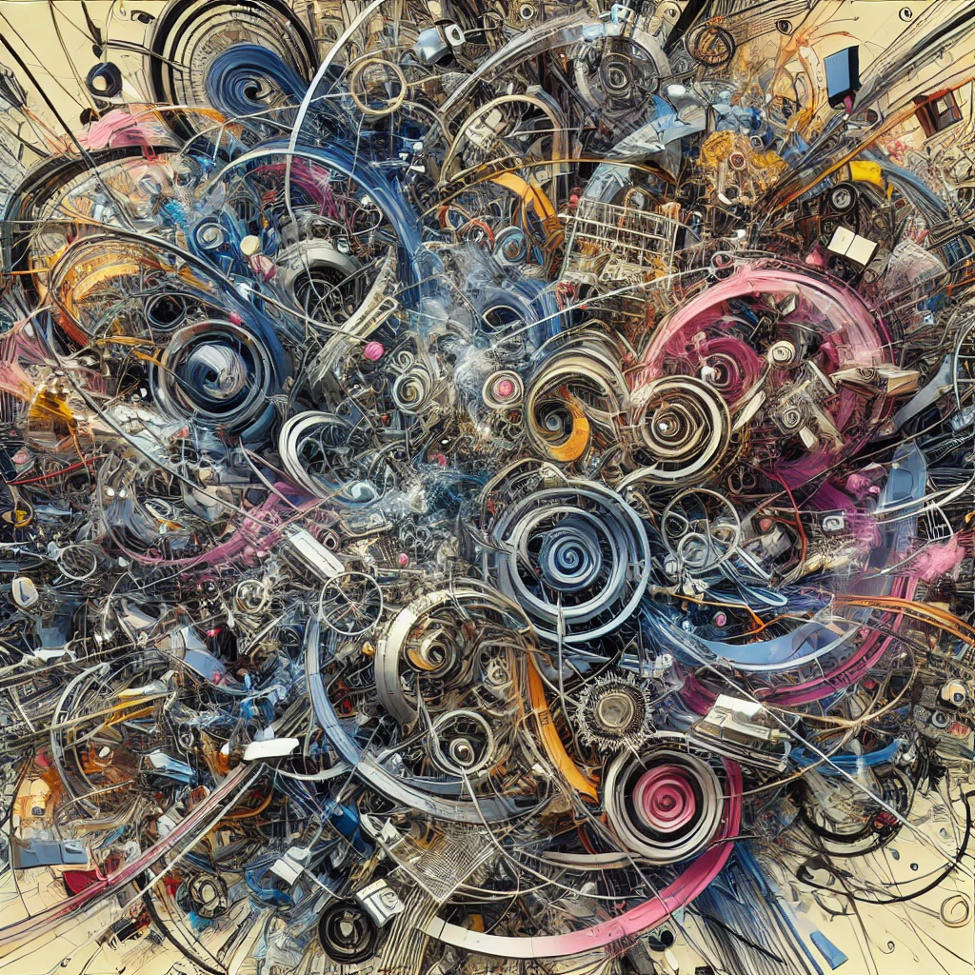
AI Generated Abstract Image of a Clusterfuck
What is a clusterfuck?
Some years ago, a young friend of mine who could swear with the best of sailors introduced me to the term “clusterfuck”. Although reportedly coined by beat/hippie poet, Ed Sanders, in his 1965 Mongolian Cluster Fuck it struck me as a fresh and lively visualization of any number of different complex and muddled messes with their associated feelings of overwhelm, frustration and of being totally stuck in an ugly situation. In trying to get a clear picture of the clusterfuck phenomenon I turned to my new best friend, AI who informed me that:
"Clusterfuck" is a slang term used to describe a chaotic, disorganized, and disastrously mismanaged situation. It often implies that multiple people or factors contributed to the confusion or failure. The term is commonly used in military, workplace, or general life scenarios where everything goes wrong at once. It’s a pretty strong and informal word, so it’s best used in casual conversations rather than professional settings.”
Stanford business professor Bob Sutton goes further, describing clusterfucks as
“those debacles and disasters caused by a deadly brew of illusion, impatience, and incompetence that afflicts too many decision-makers, especially those in powerful, confident, and prestigious groups… Whereas clusterfucks are perfectly preventable, fuck-ups are an unavoidable feature of the human condition.”
https://qz.com/work/1225213/the-difference-between-a-snafu-a-shitshow-and-a-clusterfuck
Forgive me for using a word that can be seen as only contributing to the vulgar assault-on-everything-decent in our culture, a nasty word that simply pulls the conversation down into the gutter and doesn’t enlighten anything. Especially as a professional, it is not the favored way we like to present our thoughts in public—although, in my mind, it is a most apt descriptor of what is actually happening in America today.
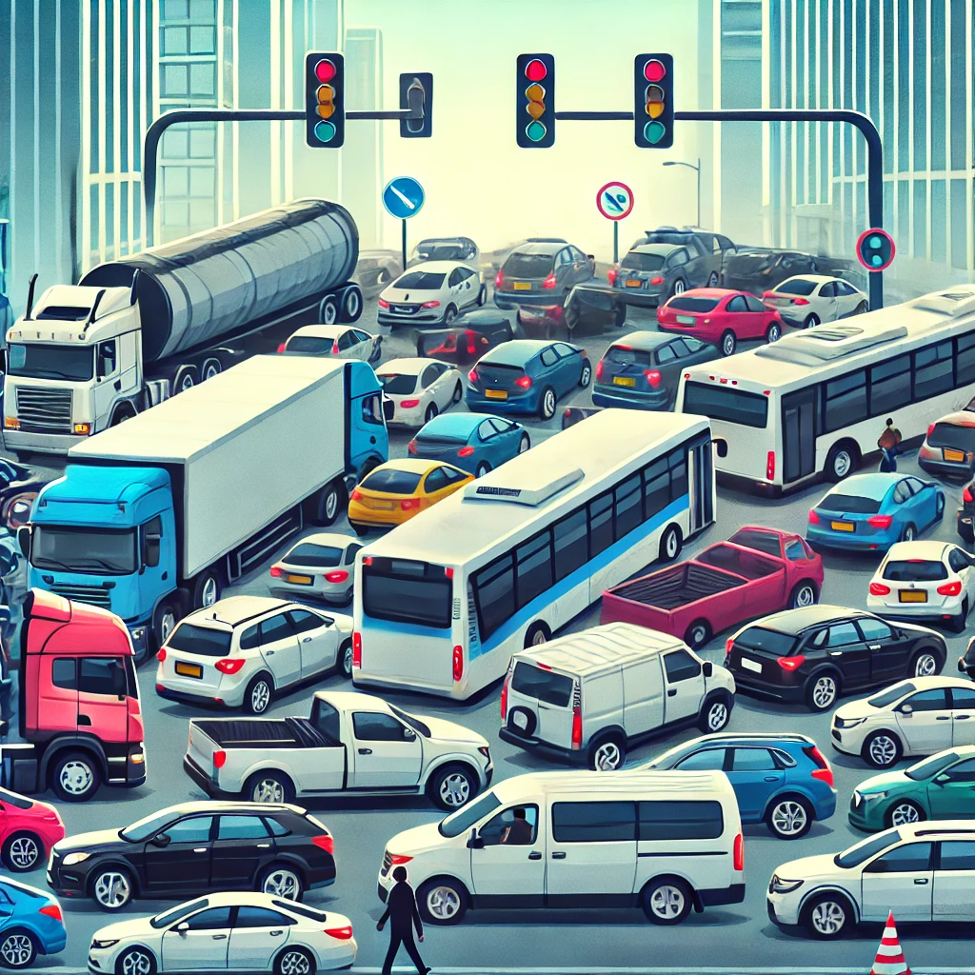
AI Generated Image of a Traffic Clusterfuck
The opening weeks of the Trump Presidency have all the earmarks of a clusterfuck by design, a carefully orchestrated attack on multiple government agencies to create chaos at every level of the Federal government. For those of us who find terrifying the dismantling of government support for scientific and medical research, environmental protection, health and human services, consumer protections, diversity, equity and inclusion efforts, foreign aid to less advantaged countries and almost everything having to do with the well-being of our society and planet, it is also a clusterfuck with potentially disastrous effects. It is now clear that Trump and Elon Musk set out quite deliberately to create a breakdown of our government and even the existing world order. To get totally in the gutter with them, I hope their goal of creating a clusterfuck in the Federal government may itself backfire and they will be clusterfucked by their own clusterfucking. Unfortunately, such a swing of the pendulum may come only after incalculable damage has already been done to the country and the world.
Most would agree that the goal of cutting back on wasteful and bloated government spending and regulation is a good thing. That’s not the issue with this protest at how Trump and Musk are preceding. The issue is how they are going about the process of cutting government bloat and spending with total disregard for the law, for the Constitution, and for the human consequences of their actions. They exhibit a mean spiritedness and ruthless insensitivity to the suffering of others that leads many to conclude that they take sadistic delight in causing pain. Trump’s suggestion that Gaza be emptied of all Palestinians shows no feeling for those who have suffered enormously and will continue to do so at his hands. But no one ever accused Trump of having empathy or real concern for others. He has never shown any signs of a philanthropic instinct. (The word “philanthropy” derives from the Greek words “philos” or “love” and “anthropos” or “man/humanity”. The Greek “philos-anthropos” means “love of mankind.)
Trump is now joined by Elon Musk who described USAID as a “criminal organization,” who compared foreign aid to “money laundering,” and called USAID employees an “arm of the radical-left globalists.” It seems ironic that the richest man in the world is attempting to cut off aid from the richest country in the world to relieve the suffering of those from the poorest countries in the world. Trump and Musk are definitely not “do-gooders”. They do not place the suffering of humanity as a high priority or as any priority whatsoever. There is no “philanthropos”, love of humanity and care for its suffering, in their agenda.
https://www.msnbc.com/opinion/msnbc-opinion/trump-musk-usaid-doge-foreign-aid-rcna190671
Although Trump has done a good job of mythologizing a “deep state” that needs to be drained, he demonstrates no knowledge or respect for civic society and the positive role government plays in safeguarding and making lives better for as many people as possible in government-supported agencies such as the CDC, US Aid, NIH, EPA, NSF.
The Fuel for the Clusterfuck Presidency
The Clusterfuck Presidency draws energy from triggering the powerful emotions and simplistic ideas of cultural complexes that are the expressions of underlying myths or deep beliefs. One of Trump’s major tools in his pursuit of dismantling the Federal government and ridding it of any humanitarian efforts is his mastery of the art of stimulating, amplifying and manipulating pre-existing cultural complexes. An activated cultural complex plays on deeply embedded powerful group emotions, simplistic black and white thinking, and the awakening of self-selecting memories based on previous experiences and beliefs that can easily sway a population that does not have the concentration span to stay focused on a single issue for more than a few seconds. This leaves daily news reporting especially vulnerable to the triggering of cultural complexes that distort information and play with facts in such a way that stories are spun to reinforce a particular narrative such as the Deep State, or the criminality of immigrants, or the perversions of DEI. Trump has become the master of exploiting cultural complexes by feeding his base the red meat of negative, emotionally-based simplistic attitudes that are often based on ignorance, disinformation and deception (such as his attacks on Dr. Fauci who disputed Trump’s “common sense” but deadly suggestion of using chloroquine to treat Covid) Arousing cultural complexes also serves his other main purpose of enraging his enemies which is something that delights Trump in his predilection to foster division, chaos and destruction. This is clearly his preferred mode of operating and seems to serve deep characterological needs to sow conflict and hatred as a way of garnering attention and gaining power. On an almost daily basis, Trump has found a way to tweet his invasive psyche into the national and global psyche, and to promote his world view and mythology. His most effective weapon for inducing massive disturbance in the collective emotional field and for fueling his political and personal goals is by arousing the intense emotions triggered in cultural complexes that bypass and undermine all rational thought. Who would have thought to blame a recent deadly plane crash in Washington DC on DEI (diversity, equity, inclusion) policies? Who would have dared to propose both the forced exile of 2.2 million displaced Palestinians from Gaza to Egypt and Jordan and develop their land into a “second Riviera on the Mediterranean”, devoted to all the worldly pleasures off which Trump feeds his family. Only a grandiose character with a world class talent for stirring up fear, adulation and outrage every day would dare such a massively insensitive and cruel undertaking. Trump is an adept at self-promotion and self-aggrandizement which include the outrageous, the vulgar, and the ugliest of all human tendencies. His Clusterfuck Presidency is fueled by his lunging from one intersecting cultural complex to the next. He thrives on detonating nasty conflicts by stepping on as many complexes as he can to create a sense of his own power through his ability to create disruptive chaos. He is a practitioner of what Steve Bannon advised as a way to defeat the dreaded, combined enemy of the media and the Left: “Flood the zone with muzzle velocity.”
Four interconnected cultural complexes form the core of Trump’s mythology and are used to fuel his agenda:
the anti woke, anti DEI, anti politically correct cultural complex
the anti Deep State cultural complex
the anti undocumented immigrant cultural complex
the anti elite cultural complex
These are the mainstays of Trump’s playbook. He resorts to them to rally his base any time he needs support for a particularly loathsome outcome or to divert attention by scapegoating an enemy. Like our dream of nuclear fission these highly reactive culture complexes provide an unlimited source of free energy for his battles.
1. the anti woke, anti DEI, anti politically-correct cultural complex
Early on in his 2016 campaign, Trump found the theme of “political correctness” particularly ripe for generating hostility in a growing segment of the population that had wearied of being made to feel “incorrect” because they harbored negative feelings about a culture moving away from more traditional attitudes with regard to gender identity, racial identity, ethnic identity. As progressives got more strident in insisting on “diversity, equity, and inclusiveness” a strong conservative backlash was developing in a revolt against wokeness and cancel culture. Trump has been able to tap into the growing polarization around the cultural complex of political correctness, wokeness, and cancel culture. This sentiment has found its most recent expression in Trump’s terminating "illegal DEI and 'diversity, equity, inclusion, and accessibility' (DEIA) mandates, policies, programs, preferences, and activities in the Federal Government, under whatever name they appear."
As a specific example of this policy, Veterans Administration doctors have been warned not to use the word “equity” or to promote DEI-based programs. Many corporations seem to be following Trump’s lead in eliminating DEI programs.
2. The anti Deep State cultural complex
As another tool in his arsenal of inflammatory weapons Trump also embraced the preexisting Deep State conspiracy theory that dated back to the John Birch society which originated in 1958. It claimed the existence of a clandestine network of left wing agents that operated behind the scenes both within the US government, especially within the CIA and FBI, and at the highest levels of non-governmental financial and industrial institutions. In appropriating this notion, Trump used it as fuel to delegitimize his critics by accusing the Deep State of seeking to destroy him and his agenda. He has linked this notion with Ronald Reagan’s 1981 presidential inauguration speech “Government is not the solution to our problem; government is the problem.” This ideology finds clear expression in Jason Chaffetz’ Deep State in which he argues that there is a politicized federal bureaucracy that actively works to promote the Democratic agenda and undermine President Trump. Trump promises a simple solution: rid democracy of the “deep state, ” and “empty the swamp”. His vengeance and retaliation against the Deep State is finding concrete expression in his firing officials from US AID, the FBI, CIA, and any government agency and civil service that is perceived as not being loyal to Trump.
3. The anti undocumented immigrant cultural complex
The biggest boogeyman in the Trump arsenal of cultural complex weapons has been the illegal and criminal immigrant. His claim that 13,000 immigrant murderers were currently live in the United States has been an effective weapon at stirring up deep fear and resentments about all immigrants. These are the kind of statements Trump has made to stir distrust and hatred of immigrants:
“They will take your jobs.”
"They will walk into your kitchen, they'll cut your throat,"
"Small towns in America are terrified of migrants coming in and, even when they haven't arrived, they’re terrified… They will rape, pillage, thieve, plunder and kill the people of the United States of America."
Trump called illegal immigrants "animals who will take the jobs of minorities and of union workers.” By threatening to close the borders to illegal immigrants, rounding up illegal immigrants already in the United States and shipping them out of the United States to Guantanamo or other countries, Trump has fueled the fears of “others” and rallied support for his nativist ambitions.
4. The anti elite cultural complex
Trump has masterfully orchestrated an attack on the “elites” and managed to connect with the ‘non-elites” as a man of the people, a man of “common sense.” He has said, “the three most dangerous voices in America are academic elites, political elites, and media elites.” The academic elites are the economists, historians, sociologists, psychologists and other highly trained professionals who are seen as advocates of more liberal policies. The political elites are individuals whose positions in powerful institutions, organizations, and movements enable them to shape or decisively influence political outcomes. The cultural or media elites are persons who enjoy high status and influence in non-political spheres such as the arts, sports, philanthropy, professions, and civic associations. In appealing to his populist base, Trump likes to portray his judgement as “common sense” dismissing the opinions of experts such as Anthony Fauci of the CDC, or Jerome Powell of the Federal Reserve or the almost universally held opinion among scientists that climate change is real, or the widely held opinion of world class economists who argue that the use of tariffs will backfire against the US. Trump has chosen many to be part of his cabinet who have little or no expertise in the departments they are leading or who, like Robert F. Kennedy Jr., hold opinions that go against all scientific evidence.
Elites are portrayed as being out of touch with the everyday experiences and concerns of the general populace, leading to feelings of disenfranchisement among citizens. Elites are perceived as promoting cultural or political agendas that do not resonate with the broader population. Trump effectively positions himself as a champion of the "common people," contrasting their interests against those of the so-called elites. This approach resonates with individuals who feel marginalized or overlooked by traditional power structures.
By criticizing established political figures, media outlets, and institutions, Trump taps into widespread public dissatisfaction with the status quo. His rhetoric often targets perceived corruption and inefficiency within these entities, bolstering his image as an outsider challenging entrenched interests. Trump's adept use of social media platforms allows him to communicate directly with his audience, bypassing traditional media channels. This direct engagement fosters a sense of authenticity and immediacy, reinforcing his critiques of mainstream media as part of the elite establishment. Trump's rhetoric often reflects and amplifies cultural grievances, appealing to individuals who feel that their values and identities are under threat from elite-driven social changes. This cultural alignment strengthens his bond with supporters who perceive him as defending their way of life against elite encroachment.
POLITICALLY CORRECT, WOKE/DEI
ILLEGAL, CRIMINAL IMMIGRANT
DEEP STATE
ELITES
In bundling all of these potent, cultural complex trigger words together Trump has concocted a toxic brew that he can serve up to his “base” at any given moment and stir up all of their fears, resentments, envies, and feelings of being disenfranchised and forgotten by the government and its leaders.
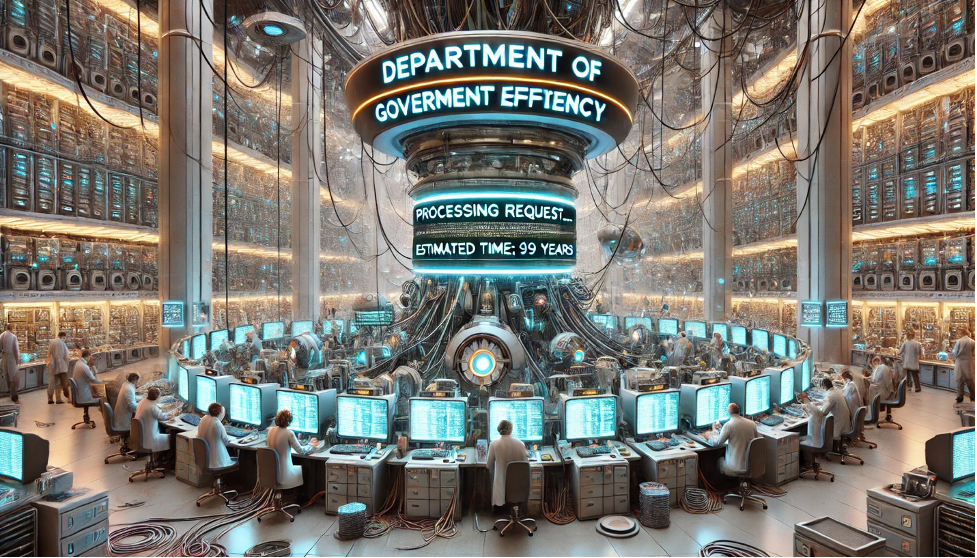
AI Generated Image of The DOGE Clusterfuck
Part 2 - The Spiral Progression and Regression of Cultural Complexes over Time
If we are firmly in the grips of an intersecting clusterfuck of cultural complexes fueling a most dangerous moment in our nation’s history with many fearing for the fate of democracy as we know it, how do we deal with this dire threat? This is the essential question to which there are no clear answers at this time. Taking to the courts to challenge the many illegal actions of the current administration is the first and obvious legal step. But how an effective resistance will be mobilized over time is not clear. Moreover, it will take time. The goal, of course, is to help shift the pendulum away from the mood and political power that is firmly in Trump’s hands at this time. In the meantime, we can begin by trying to place what has been happening in the first few weeks of Trump’s Presidency into some sort of context as a way to gain perspective and hopefully some equilibrium in a dizzying, destabilizing time. There is some solace in the statements:
“We have been here before.”
“The pendulum will swing back.”
“This too will pass”.
We have no guarantee what has been true in the past will be true in the future. But these perspectives are worth considering, even if they also serve a defensive function of allowing us to escape if even for a moment the horror of what is actually happening now to the United States government and to our people. Some of us “have been here before” in the sense of seeing our government and our leaders as a dire threat to what we cherish most about being an American. We have witnessed the destruction of what we considered most valuable as we waged war abroad and rioted at home. The 1960’s and early 1970’s saw the assassinations of John F. Kennedy, Martin Luther King, Robert Kennedy, the war in Vietnam, racial strife and violence at home, the emergence of the counterculture and the era of Nixon’s Watergate. All contributed to a sense of deeply threatening and uncertain times. Robert Rauschenberg captured the “clusterfuck” of this era when everything seemed to be spiraling out of control.
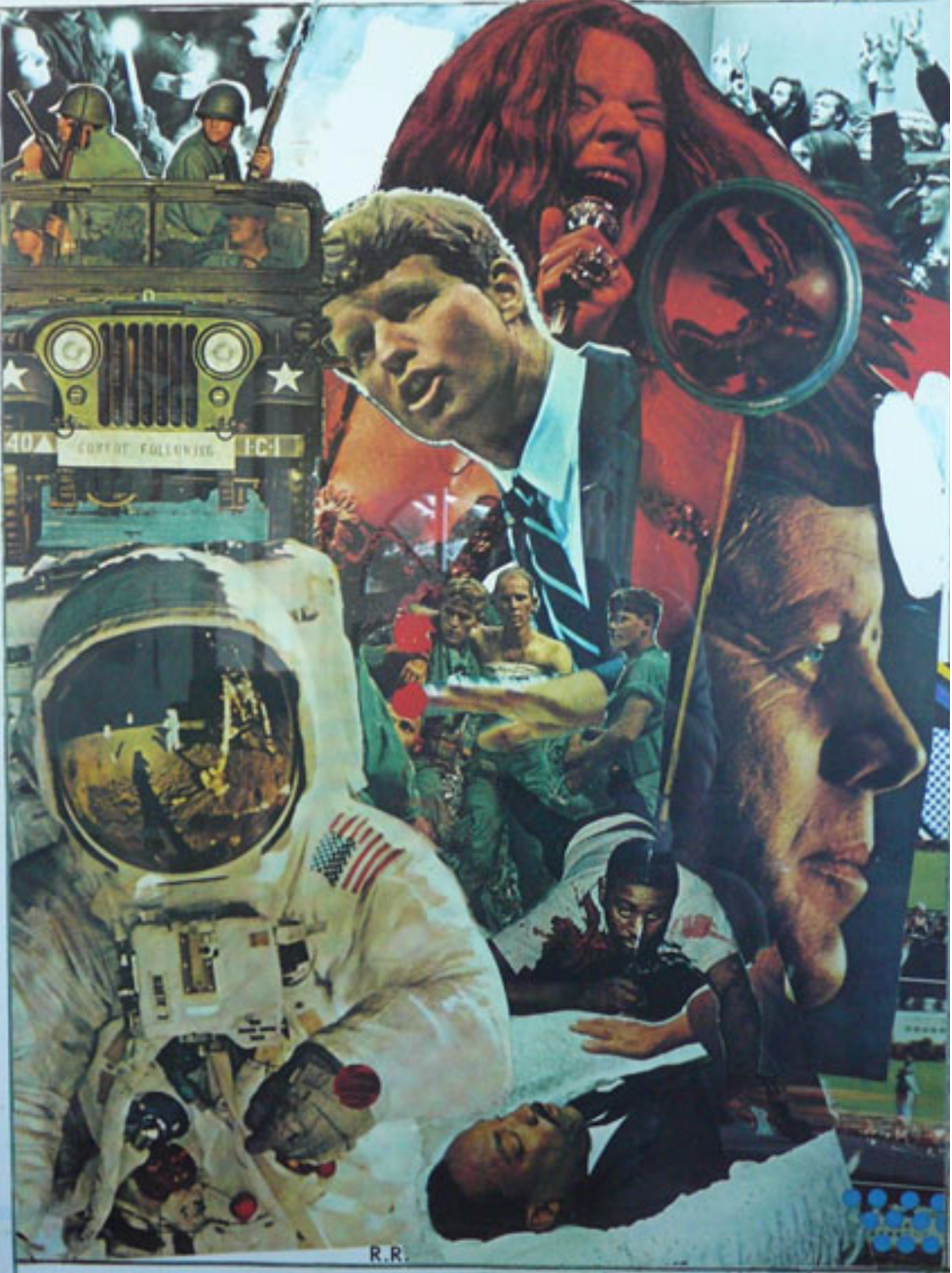
Robert Rauschenberg Signs 1970
But the fact is that the world did not end, even when it appeared as if everything that could go wrong was going wrong at once. Francis Ford Coppola’s Apocalypse Now captured the desperate violence of the times, but the apocalypse did not come home to America. It is also true that the world did not change much for the better in the way we hoped it would in terms of peace, justice, and wellbeing. Over time, we got a mixed bag. Neither the worst nor the best was realized. More recently, Obama and others have tried to reassure us that Trump and Trumpism too will pass. They remind us that history teaches us that what appears immutable and even eternal at one moment, changes and becomes something quite different in the next moment. The experience of time and change can be a great teacher. I have considered this historical approach in my work on cultural complexes and how we might look at our current crisis in the context of that model. I have come to think in terms of spirals and periods of progression and regression rather than a belief in straight line progress or doom’s day horror. (the belief in continuous progress is an American cultural complex if there ever was one) At this moment, whatever progress we seem to have made around diversity, equity and inclusiveness, environmental protections, gender equality, belief in scientific and scholarly research, and perhaps most importantly a foundational belief in the value that government, business and individuals all have a stake in making the human condition better are all in profound retreat. Will we spiral out of this deeply regressive phase or will we simply spiral out of control as is portrayed in the first AI generated image of the clusterfuck presidency with all the spiral images simply floating around willy nilly?
I want to give an example of how the notion of the spiral evolution of cultural complexes can help place our current situation in a historical perspective that offers some hope for things not just indefinitely spiraling out of control, that there is a sort of pendulum effect that will cause things to swing back from the madness of our current moment. Think of the spiral as a symbolic image of how the American psyche cycles through different phases of embracing and rejecting certain values as expressed through cultural complexes unfolding over time. The example I will use to bring this idea into focus is the unfolding progression and regression of the most virulent and long-lasting cultural complex in our American experience: the racial complex.
The image of the spiral as a way to think about change over time was well known to the Minoans of Ancient Greece in 1500 B.C.
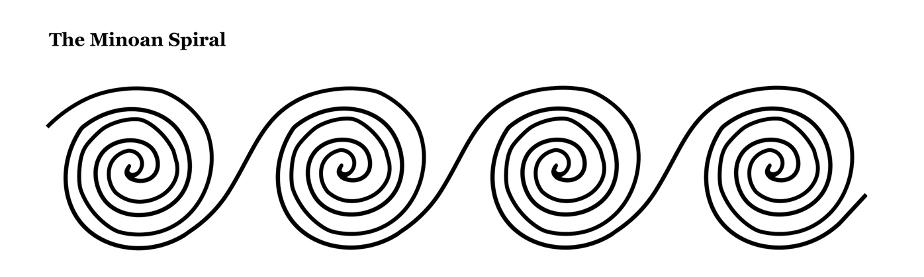
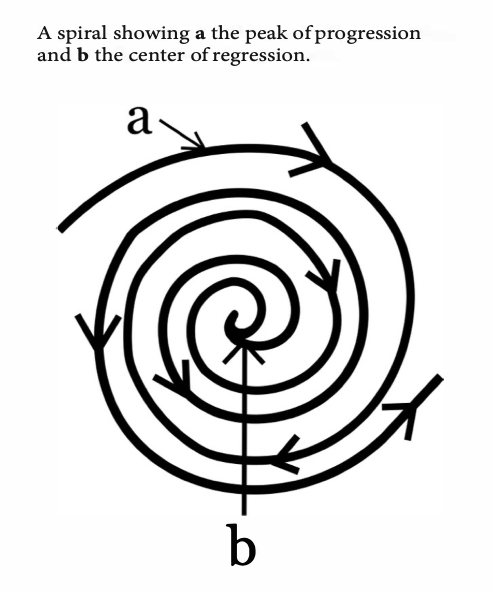
Change over time, especially the change in how groups imagine themselves, is not linear. It goes in and out, up and down, backwards and forwards. And yet there is a progression from left to right over time.
In a more detailed image of a single spiral as an expression of the movement of the group psyche and its cultural complexes, we note that the psyche of the group (b), has spiraled back in on itself in a “regression” and then unfolds again outward and forward in what can be thought of as a “peak of progression” (a).
What a society does with its cultural complexes over time is one way to imagine and to get a visceral feel for the development of the soul of a country. For example, we can look to America’s long struggle with the racial complex as a good indicator of the evolution of our country’s soul. Toni Morrison’s description in Beloved of a house haunted by the spirits of black ancestors is like an X-ray of the damage that has been done to white and black people alike in the virulence of racial discrimination. She speaks through the experience of her character, Stamp Paid:
… he believed the undecipherable language clamoring around the house was the mumbling of the black and angry dead. Very few had died in bed … and none that he knew of … had lived a livable life. Even the educated colored: the long-school people, the doctors, the teachers, the paper-writers and businessmen had a hard row to hoe. In addition to having to use their heads to get ahead, they had the weight of the whole race sitting there. You needed two heads for that. Whitepeople believed that whatever the manners, under every dark skin was a jungle. Swift unnavigable waters, swinging screaming baboons, sleeping snakes, red gums ready for their sweet white blood. In a way, he thought, they were right. The more colored people spent their strength trying to convince them how gentle they were, how clever and loving, how human, the more they used themselves up to persuade whites of something Negroes believed could not be questioned, the deeper and more tangled the jungle grew inside.
But it wasn’t the jungle undocumented immigrants brought with them to this place from the other (livable) place. It was the jungle whitefolks planted in them. And it grew. It spread. In, through and after life, it spread, until it invaded the whites who had made it. Touched them every one. Changed and altered them. Made them bloody, silly, worse than even they wanted to be, so scared were they of the jungle they had made. The screaming baboon lived under their own white skin; the red gums were their own.[i]
The souls of both White and Black people have been infected for centuries with the psychic virus of racism and its toxic spread of the archetypal image of the jungle and its black natives as being like “swinging screaming baboons, sleeping snakes, red gums ready for their sweet white blood.”
That is our starting point in the history of the racial cultural complex in America. It has now extended itself to the "undocumented, criminal immigrants" that Trump is urging us to fear and hate and into which he is urging us to project our own worst nightmares, "the jungle whitefolks planted in them".
Here is a very rough sketch of the spiral progression and regression of the evolution of the racial complex in the United States over a four hundred year time span.
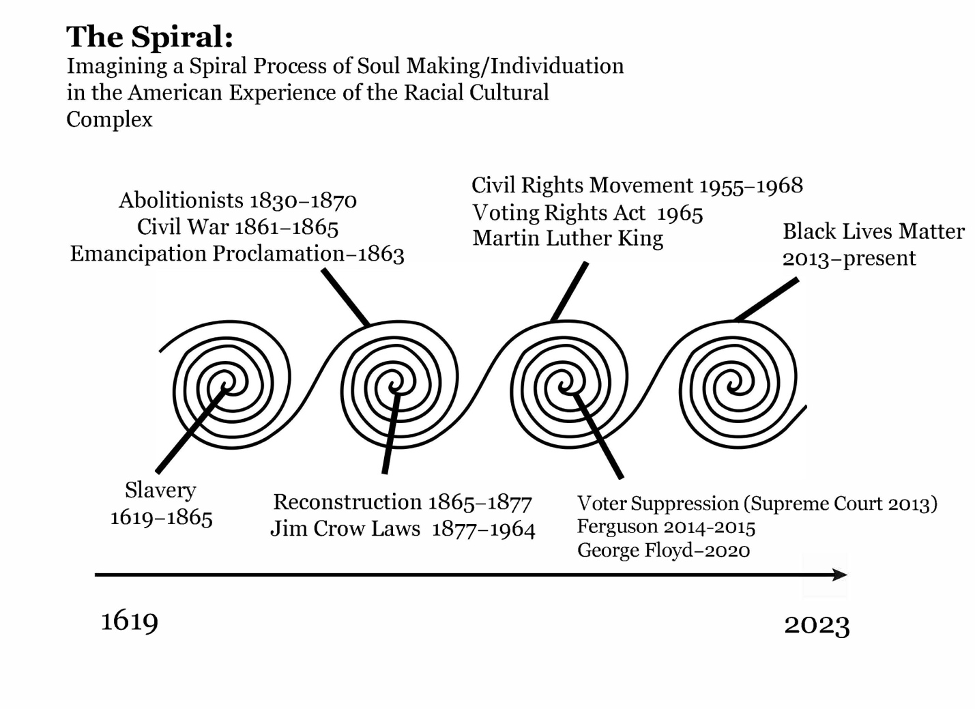
I will not go through a more detailed history of each phase as others have done it much better and more thoroughly than I ever could. But by teasing out in some broad strokes the movement of progression and regression, I suggest one way to imagine the relationships between a cultural complex, soul-making, and whatever individuation of our society has taken place at the level of the collective psyche. These nodal points on the spiral are the tip of the iceberg or landmark moments when the complex breaks through to collective consciousness by expressing itself in a significant event that symbolizes a turning point or peak of progression or regression. It is important to note that in bipolar cultural complexes, what one group defines as progression may be seen by its polar opposite group as regression. What is most important in this analysis is not that individuals or societies have cultural complexes. This is just a basic psychological fact of being human and living in human societies. As I have written elsewhere:
My thesis, then, is that the American soul is embedded in our various cultural complexes. Furthermore, our cultural complexes are what give political life its dynamism and its content. Both the energy and the issues of political debate spring from the autonomous, highly charged emotional material of our core cultural complexes. Political life is the natural social arena in which cultural complexes play themselves out. We forge the American soul in our struggle with our cultural complexes. In the political arena, cultural complexes seem mostly to generate heat, division, hatred; they are inflammatory and polarizing; they usually end in a stalemate without any resolution, only to recur in the next election or the next generation; sometimes they are ignored or kept unconscious for decades; occasionally they can be worked out slowly in engagement, compromise, reconciliation, and healing after generations of recurring battle. In short, they behave like complexes.[ii]
The soul of America then and, by extension, our individuation as a nation depends on what we do over time—sometimes hundreds of years or more—with our cultural complexes. This is nowhere truer than with the cultural complex of racism in America. And also it is absolutely true that the progress with racism in the United States over time has been anything but a straight line. It is marked by progression and regression over and over again, sometimes with both progression and regression occurring at the same time. No one symbolic image of that process, such as the spiral, can do justice to the unpredictable vicissitudes of the course that racism has taken in America through the centuries. But the image of the spiral as being apt for the course that personal and cultural complexes can take is not a bad place to begin as it sees the natural course of such processes as one of progression and regression.
For more progressive Americans, a soul-making and individuating engagement with the deeply entrenched American racial complex has expressed itself positively in the following landmark moments of our history: Abolitionists (1830–1870), the Emancipation Proclamation (1863), the civil rights movement (1955–1968) and Voting Rights Act (1965), Black Lives Matter (2013–) and other contemporary protest movements against racism. The negative nodal points of regression for progressives in the history of the racial complex are most prominent in slavery itself (1619–1865), Reconstruction (1865–1877), and Jim Crow laws (1877–1964), and now renewed voter suppression (2013–present) and increased police brutality against blacks, as seen in the deaths of Michael Brown in 2014 in Ferguson, Missouri; Breonna Taylor in Louisville, Kentucky, and George Floyd in Minneapolis, Minnesota, in 2020, among many, many others. When we find ourselves at the nodal point of regression anywhere along the spiral progression of the slavery complex (all the point b’s in the diagram), it feels as though nothing has ever changed. From the perspective of being at point b anywhere in the spiral progression of the racial complex over time, it feels as though America has done nothing to redeem the suffering of slavery, reconstruction, or voter suppression. The suffering of black people has always been terrible and will always be terrible. Nothing will ever change. At other points along the cultural complex’s path of spiral progression, there can be hope that there has been change and there will continue to be positive developments in the future.
I simply reverse this perspective for racists who tend to see the peak positive moments in the racial complex in slavery itself, Reconstruction, and Jim Crow laws, renewed voter suppression and increased police brutality against blacks. And racists will tend to see the peak “regressive” moments of the racial complex in the abolitionists and the Emancipation Proclamation, the civil rights movement and the Voting Rights Act, and the emergence of Black Lives Matter and other contemporary anti-racist movements such as DEI (Diversity, Equity, Inclusion).
In looking at this spiral representation of the evolution of the racial complex in America, we are forced to ask whether or not there has been any progress. There is certainly movement over time, but it would be easy enough to say that the moments of regression are simply a recapitulation of the original sin of slavery. It is in the very nature of a complex to see the same old issues recycling with self-selecting memories that reinforce one’s point of view, with the same potent emotions that simply accumulate more and more power over time, and the same old convictions that express themselves in black-and-white simplistic ideas that are autonomous, repetitive, and self-perpetuating. The Toni Morrison quote of Stamp Paid is a poignant example of the unchanging psychological fact of the existence of the racial complex over time. Again, that prompts the question of “has there been any real change?” On the one hand, there is the critique of the progressive myth of history that says, “History does not have sides. It does not take sides. The progressive view of history is a myth. History is perfectly capable of slamming into reverse and backing up at 50 miles per hour.”[iii]
On the other hand, Eric Ward, a civil rights leader for more than thirty years, gives a clear sense of the underlying progress in the movement over time with the nation’s encounter with the racial cultural complex.[iv]
I know 2020 is fundamentally better in this country than 1920. And I absolutely know 2020 is better than 1820 in this country. And that doesn’t mean that I think everything is marvelous. It doesn’t mean that I’m ignoring the inequality and the injustice that exists in our society. What I’m noting is that we’re in a better place. Now, why are we in that better place? As a person on the left and as a progressive, are we in a better place because capitalism made this a better place? I’m skeptical, though capitalism has had its own role to play, and I’ll acknowledge that. Are we in a better place because folks who were bigoted decided “It’s time to be in a better place”? No. We are in a better place because folks like me and folks like you and folks like those listening really struggled for generations, for hundreds of years, to get us to this point. And one of the things that the impact of authoritarian thinking does to our movement in its insistence on purity and a unilateral narrative is, when we look back, to disregard the work that people did for us to get us to this point. They died for it. They were beaten for it. They were ostracized for it. They were persecuted for it in ways that I can’t even imagine.
If we are building a society that cannot acknowledge the work that got us to this point, how do we acknowledge the work that it’s going to take to get us to 2120? And what type of democracy do we want or what type of society are we saying we want in 2120? And so I feel like that long-arc thinking is really important. I also think this is critically important—life has been unfair for the majority of Americans, for the majority of people of color and other marginalized communities in this country, and for the majority of the world. Life is unfair. It is harsh in ways that are unnecessary. It is costing in ways that are unnecessary. This has benefited a smaller grouping of folks in our society who have benefited from that privilege—whether they are male, whether they are straight, whether they are white—in lots of different ways. But the truth is that we’re not seeking revenge here. That shouldn’t be our goal, ever.[v]
Eric Ward knows deep in his bones the evolution over time of the racial complex in America. He has inherited the sensibility of Stamp Paid’s deep suffering from Toni Morrison’s Beloved. Ward knows there has been progression and regression. Ward also knows that there has been real progress. And, Ward knows that struggling with our racial cultural complex is a most arduous soul-crushing as well as soul-making process. Perhaps it is even an individuating process for the American people and the American psyche.
What I want to suggest is that this same spiral analysis for the evolution over time of the racial complex in America can be applied to the cultural complexes that have now taken possession of a sizeable group of our population. We are witnessing the effects of that process in the daily announcements of Trump’s administration, all of which are responding to the potency of:
the anti woke, anti DEI, anti politically correct cultural complex
the anti Deep State cultural complex
the anti undocumented immigrant cultural complex
the anti elite cultural complex
These are not the only cultural complexes that contribute to our current emotional and political climate. But they are the ones that seem to be most visibly in play as motivators. The question is whether the pendulum will swing in the unfolding over time of these cultural complexes and their impact on our society. Perhaps the only thing we know with some certainty is that, when the dust settles on the Trump Presidency, Donald Trump and Elon Musk will most likely be far wealthier and the rest of America will probably be poorer.
This essay ends with a question, not an answer. Can we take solace in the belief that the pendulum will swing back to a more balanced attitude to our society’s basic cultural complexes or has time run out and the pendulum is broken?

AI Generated Image: Has Time Run Out and the Pendulum is Broken?
[i] Toni Morrison, Beloved (New York: Alfred A. Knopf, 1987), 234.
[ii] Singer, “A Personal Meditation,” 137.
[iii] William Deresiewicz, “There Is No Right Side of History,” The Free Press, January 2, 2023, https://www.thefp.com/p/there-is-no-right-side-of-history?utm_source=substack&utm_medium=email.
[iv] Eric K. Ward is a nationally recognized expert on the relationship between authoritarian movements, hate violence, and preserving inclusive democracy. In a civil rights career spanning more than thirty years, he has worked with community groups, government and business leaders, human rights activists, and philanthropists. Eric is executive director of the Western States Center. He’s also a senior fellow with the Southern Poverty Law Center and Race Forward, and he’s co-chair for the Proteus Fund.
[v] Eric Ward, “Justice, Rage, and Peace,” Mind of State podcast, December 9, 2020, https://mindofstate.com/justice-rage-and-peace/.
Great to come across this, Tom. So what’s the distinction between clusterfuck and anarchy?
Excellent as always, Tom. A long-view perspective is helpful in these times to allow us to reflect and generate hope.